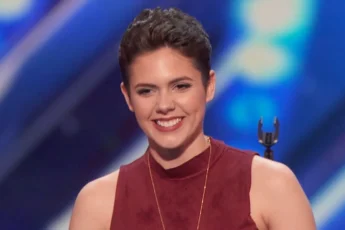
Robert Finley is a 65-year-old war veteran who recently stepped onto the America’s Got Talent stage and delivered a performance that reminded everyone watching that it is never too late to pursue the dream that still lives inside you. His entrance alone carried weight. Guided out with confidence and warmth, and accompanied by Terry Crews, Robert didn’t appear as someone defined by limitations, but rather as someone shaped by experience. Despite being blind, he moved with ease and assurance, smiling as he took in the energy of the crowd around him. There was something instantly magnetic about him—not loud or performative, but grounded, like someone who had lived enough life to understand exactly who he is.
Before he even sang a note, Robert shared a part of his story that added even more depth to the moment. He spoke about his time in the military and the life he built afterward, but also about the difficult reality of losing his sight later in life. For many, such a change could feel like an ending, but for Robert, it became a turning point. Rather than stepping away from the world of music, he found himself drawn back to it with even more purpose. Music, which had always been a part of his life, became something deeper—something that helped him process, express, and continue moving forward. That honesty in his story immediately resonated with the audience. You could feel the room shift into a quieter, more attentive state, as if everyone understood they weren’t just about to watch a performance—they were about to witness a life being shared through song.
When Robert finally began to sing his original track, “Get It While You Can,” the entire atmosphere in the theater transformed. The opening notes carried a raw, bluesy texture that immediately set the tone. His voice wasn’t polished in a commercial sense, but it didn’t need to be. It was rich, soulful, and full of character, the kind of voice that feels like it has lived through every lyric it delivers. There was a natural grit in his tone that brought to mind the great blues legends of the past, yet at the same time, his delivery felt completely his own. It wasn’t imitation—it was identity.
As the song unfolded, Robert’s confidence grew with every phrase. He leaned into the rhythm with ease, clearly comfortable in his element. The band behind him amplified the energy, but it was his voice that carried the performance. There was a kind of joy in the way he sang, a sense that he wasn’t just performing for approval, but genuinely enjoying the act of making music in that moment. The judges, initially observant and curious, quickly shifted into full engagement. Simon Cowell, Julianne Hough, Gabrielle Union, and Howie Mandel could be seen reacting in real time, exchanging glances that reflected surprise, admiration, and genuine appreciation. It wasn’t just that Robert was good—it was that he was captivating in a way that felt effortless and authentic.
One of the most striking aspects of the performance was how it affected the audience. As the tempo picked up and the energy of the song grew, people in the crowd began to respond instinctively. Heads nodded to the rhythm, hands clapped along, and eventually, more and more people rose to their feet. What started as attentive listening turned into full participation, as the room filled with movement and sound. Robert’s performance had that rare quality of not just being watched, but being felt. It pulled people into it, inviting them to share in the moment rather than simply observe it.
There was a particularly powerful feeling in the later part of the song, where Robert’s voice carried even more intensity and emotion. You could sense that he wasn’t just singing lyrics—he was expressing something personal, something rooted in his life experiences. That emotional truth gave the performance a depth that went beyond technical ability. It became about resilience, about joy found in unexpected places, and about the ability to keep creating even after life has changed in profound ways.
When the final note rang out, the response was immediate and overwhelming. The audience erupted into a standing ovation, the applause echoing through the entire theater. People weren’t just clapping for a good performance—they were reacting to a moment that had clearly touched them. Robert stood there visibly moved, taking in the energy around him, his expression reflecting both gratitude and disbelief at the reception he was receiving.
The judges quickly followed with their feedback, and Simon Cowell, in particular, offered heartfelt praise. He emphasized Robert’s incredible spirit and undeniable talent, pointing out that moments like this are exactly what the show is meant to showcase. It wasn’t just about singing ability; it was about humanity, perseverance, and the power of sharing your story through art. Each judge echoed similar sentiments, acknowledging both his vocal strength and the emotional weight of his performance.
With four enthusiastic “yes” votes, Robert Finley advanced to the next round, but his impact had already gone far beyond the competition itself. In just a few minutes on stage, he had managed to leave a lasting impression not only on the judges and audience present, but also on viewers watching from home. His journey served as a powerful reminder that passion doesn’t fade with age, that creativity can survive life’s hardest challenges, and that some of the most meaningful performances are not just heard—they are deeply felt.