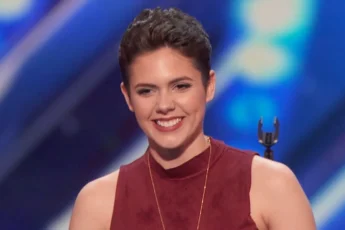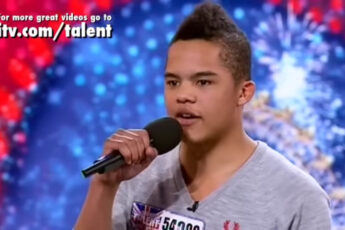
A 14-year-old from Alabama named Reid Wilson walked onto the America’s Got Talent stage with a nervous energy that was impossible to hide, standing under the bright lights as he faced the biggest audience of his young life. You could see it in the way he shifted his weight, the slight hesitation in his smile, and the way he took a breath a little too sharply before speaking. Still, there was something endearing about his calm honesty as he explained that he had been singing since he was a small child, but only recently started seriously developing his talent and performing in front of audiences. This wasn’t someone who had spent years chasing fame in front of cameras—it was a teenager just beginning to step into his potential. The judges responded warmly, trying to ease his nerves, with Howie Mandel reminding him that everything could change in just two minutes on that stage. Those words seemed to hang in the air for a moment, almost adding more pressure, but also hinting at the possibility of something extraordinary. Even with all the anxiety, Reid’s humility and soft-spoken personality quickly connected him with both the judges and the audience, who could sense there was real talent waiting to be uncovered.
The moment Reid began his performance of “You Don’t Own Me,” everything shifted in a way no one in the room seemed prepared for. The nervous teenager who had walked out moments earlier seemed to dissolve into the music, replaced by a performer with striking confidence and emotional control. His voice carried a richness and maturity that felt far beyond his age, surprising the judges almost immediately. There was a soulful depth in his tone that made the performance feel less like a cover and more like a personal statement. As he moved through the song, he began to gain momentum, growing more comfortable with every line. Midway through the performance, he made a bold decision to pull the microphone off the stand, stepping into a more dynamic presence on stage. That small but confident gesture changed the energy completely, signaling that he was no longer just trying to survive the moment—he was owning it. The audience responded instantly, sensing the shift as his performance became more expressive, more grounded, and far more powerful than anyone expected from someone his age.
By the time he reached the final stretch of the song, the entire atmosphere inside the theater had transformed. The initial curiosity had turned into full-blown admiration, with the crowd visibly reacting to each strong vocal moment. The judges, who had started the performance with supportive smiles, were now watching in clear amazement. Heidi Klum and Sofia Vergara both praised his “star quality,” noting that there was something special about the way he carried himself once he let go of his nerves. It wasn’t just about hitting the right notes—it was about presence, emotion, and the ability to command attention without forcing it. Howie Mandel, visibly moved by what he had just witnessed, told Reid that one of his biggest dreams was about to come true right there on the stage. The weight of those words seemed to catch up with the moment as silence briefly filled the room, just before the most dramatic turn of the night.
In an unforgettable climax, Howie pressed the Golden Buzzer, sending a burst of golden confetti raining down over the stage as the audience erupted in shock and celebration. Reid stood frozen for a second, completely overwhelmed, as the reality of what had just happened began to sink in. The same nervous teenager who had walked out moments earlier was now standing in the middle of a life-changing moment that most performers only dream of. Tears, disbelief, and joy all seemed to collide at once as he looked around the stage, trying to process the applause and the glowing reactions from the judges. It was a defining breakthrough, not just for his performance that night, but for his future as an artist. In that instant, Reid Wilson proved that raw talent, when paired with courage and timing, can turn a quiet dream into a life-changing reality.