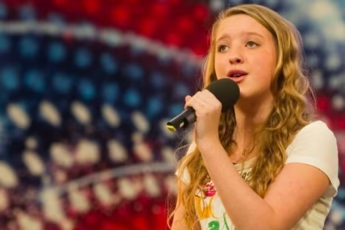
Brooke Simpson walked onto the America’s Got Talent stage with a calm confidence that immediately drew attention, but it quickly became clear that her performance would be about much more than simply impressing the judges. As a proud member of the Haliwa-Saponi tribe, Brooke carried a powerful sense of purpose with her from the very beginning. She explained that her dream was not only to succeed as an artist, but to become the first major Indigenous pop star that young Native children could look up to. Growing up, she rarely saw anyone in mainstream music who reflected her culture or background, and that absence stayed with her. Standing on that stage, she wanted to change that for future generations.
There was something deeply genuine about the way Brooke spoke before the performance even started. She did not come across as someone chasing fame for attention alone. Instead, she carried herself like an artist with a mission, someone who understood the importance of representation and the impact visibility can have on people who feel overlooked. The judges listened closely as she talked about wanting Indigenous voices to be seen and heard in spaces where they had often been ignored. It immediately gave the audition emotional weight before she had sung a single note.
Then the music began, and within seconds, the entire room transformed.
Brooke launched into a high-energy performance of “Cuz I Love You,” delivering the opening lines with a level of power that instantly stunned both the judges and audience. Her voice was explosive, soulful, and completely commanding, filling the auditorium with raw emotion and confidence. The reaction in the room was immediate. Audience members who had been quietly listening suddenly erupted into cheers as Brooke pushed into massive vocal runs and soaring notes that sounded effortlessly controlled.
What made the performance especially captivating was the balance between strength and vulnerability. Brooke did not simply sing loudly or show off technical ability. Every note carried emotion, personality, and purpose. There was a fire in her delivery that made it impossible to look away. At moments, her vocals felt deeply intimate, almost like she was telling a personal story directly to each person in the room. Then, seconds later, she would unleash enormous powerhouse notes that shook the entire theater.
Accompanying her on the keyboard was her husband, whose presence added another emotional layer to the performance. You could feel the support and connection between them throughout the audition. While Brooke dominated the stage vocally, his calm presence behind the keys grounded the performance and made it feel even more personal. It no longer felt like a television audition. It felt like watching an artist fully step into the moment she had been preparing for her entire life.
The judges were visibly stunned as the performance continued. Simon Cowell, known for his difficult standards and blunt criticism, looked genuinely impressed from early on in the song. Other judges exchanged shocked expressions as Brooke continued delivering vocal moments that rivaled the biggest names in pop music. Comparisons to artists like Kelly Clarkson immediately came to mind because of the sheer strength and control in her voice, but Brooke still managed to feel entirely original. Her sound carried elements of gospel, soul, pop, and storytelling in a way that felt uniquely hers.
As the song built toward its climax, the energy in the auditorium became electric. The audience rose to their feet before the performance had even ended, clapping, shouting, and completely feeding off Brooke’s presence. It was one of those rare audition moments where everyone in the room realizes they are witnessing something unforgettable in real time. By the final note, the theater exploded into a standing ovation.
Brooke stood on stage visibly emotional as she took in the reaction around her. Years of hard work, personal sacrifice, and determination had led to this moment, and you could see how meaningful it was to her. The judges immediately praised not only her vocals, but her identity as a complete artist. Simon Cowell described her as “the whole package,” recognizing that she possessed not only talent, but also charisma, authenticity, and a clear artistic vision. The panel unanimously agreed that Brooke had the kind of stage presence capable of filling massive concert arenas around the world.
What resonated most deeply with viewers, however, was the purpose behind her performance. Brooke was not simply trying to entertain people for a few minutes. She was making a statement about visibility, representation, and the importance of Indigenous voices in modern culture. Her audition carried emotional significance because it represented someone refusing to let her community be forgotten or erased from mainstream conversations.
The performance quickly became a viral sensation online, with millions of viewers praising not only her extraordinary vocals, but also the message behind them. People connected with her authenticity, her passion, and the way she blended cultural pride with modern artistry without compromising either side of herself. She managed to prove that representation and commercial success do not have to exist separately.
By the end of the audition, it was obvious that Brooke Simpson was far more than just another contestant hoping to survive the next round. She felt like an artist already prepared for the global stage, someone ready to make a lasting impact on the music industry. Her performance was not simply an introduction—it was a declaration that she had arrived, and that her voice, along with the voices she represents, would no longer be ignored.