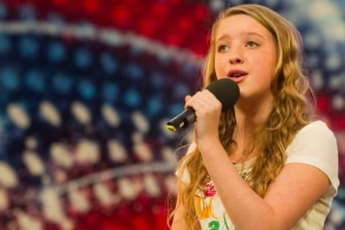
The audition stage of America’s Got Talent witnessed one of its most heart-wrenching moments when thirteen-year-old Evie Clair stepped into the spotlight. Hailing from a small town in Arizona, the young singer didn’t just walk onto the stage—she carried with her a story that immediately set her apart. There was a quiet nervousness in her posture, but also a kind of calm determination that drew people in before she even sang a single note. As she introduced herself, the audience listened politely at first, but the tone in the room shifted the moment she began to share what her family was going through.
Evie revealed that her father had been diagnosed with stage four colon cancer and given only a five percent chance of survival. It was the kind of statistic that instantly silences a crowd. Yet what made her story even more moving was what she said next: despite the diagnosis, despite the physical toll of treatments, her father continued to work as much as he could to support their family. That detail—simple but powerful—painted a picture of resilience, of a father refusing to give up even when the odds were stacked against him. You could see the judges soften, their expressions shifting from curiosity to genuine empathy.
When the music began, the atmosphere in the room changed again. The opening notes of “Arms” by Christina Perri filled the theater, and Evie closed her eyes for a brief moment, almost as if grounding herself. She had chosen the song for a reason—it was something she sang to her father during his hardest days. That context made every lyric feel heavier, more personal. As she started singing, her voice came through clear and steady, carrying a softness that felt intimate rather than timid. It wasn’t just about hitting the right notes; it was about what those notes represented.
There was a rawness to her performance that’s hard to teach. At certain moments, her voice wavered just slightly—not from lack of control, but from the weight of emotion behind the words. Instead of weakening the performance, it made it stronger. It reminded everyone in the room that this wasn’t just a performance for television; it was a daughter expressing love, fear, and hope all at once. The camera occasionally cut to the judges, some of whom were visibly emotional, their eyes glistening as they listened.
What stood out even more was Evie’s composure. For someone so young, standing on such a massive stage, carrying such a personal story, she maintained a level of vocal control that many seasoned performers struggle to achieve. She didn’t overdo it or try to impress with unnecessary runs or theatrics. Instead, she let the simplicity of the song and the honesty of her delivery speak for itself. That restraint made the performance feel authentic, almost as if she was singing directly to her father rather than to a national audience.
By the time she reached the final chorus, the entire room seemed to be holding its breath. Audience members wiped away tears, and even those who hadn’t heard her backstory could feel that something deeply meaningful was unfolding. When the last note faded, there was a brief moment of silence—one of those rare pauses where people need a second to process what they’ve just experienced. Then the applause came, loud and immediate, rising into a standing ovation that felt less like routine and more like a collective acknowledgment of something special.
The judges, usually quick with commentary, took a moment before speaking. When they did, their words reflected more than just praise for her talent. They spoke about her bravery, about the courage it took to stand on that stage and share such a personal piece of her life. One judge pointed out that what she had done went beyond entertainment—it was a reminder of why stories like hers matter. It wasn’t just about competing or advancing in the show; it was about connection, about using music as a way to communicate something words alone often can’t.
Evie’s audition quickly became a viral sensation, but not for the usual reasons. It wasn’t flashy or overproduced. It resonated because it felt real. People from all over the world saw a piece of their own struggles reflected in her story—whether it was dealing with illness in the family, holding onto hope during difficult times, or simply finding strength in moments when it feels like there isn’t any left. Her performance became more than just a clip online; it became a source of comfort and inspiration.
In the end, what made that moment unforgettable wasn’t just her voice, though it was undeniably beautiful. It was the combination of her sincerity, her courage, and the love she so clearly had for her father. Through a single song, she managed to turn a painful reality into something meaningful, something that brought people together. And in doing so, she reminded everyone watching that even in the face of uncertainty and hardship, there can still be moments of connection, strength, and hope.